Postcard of the Month: December 2025

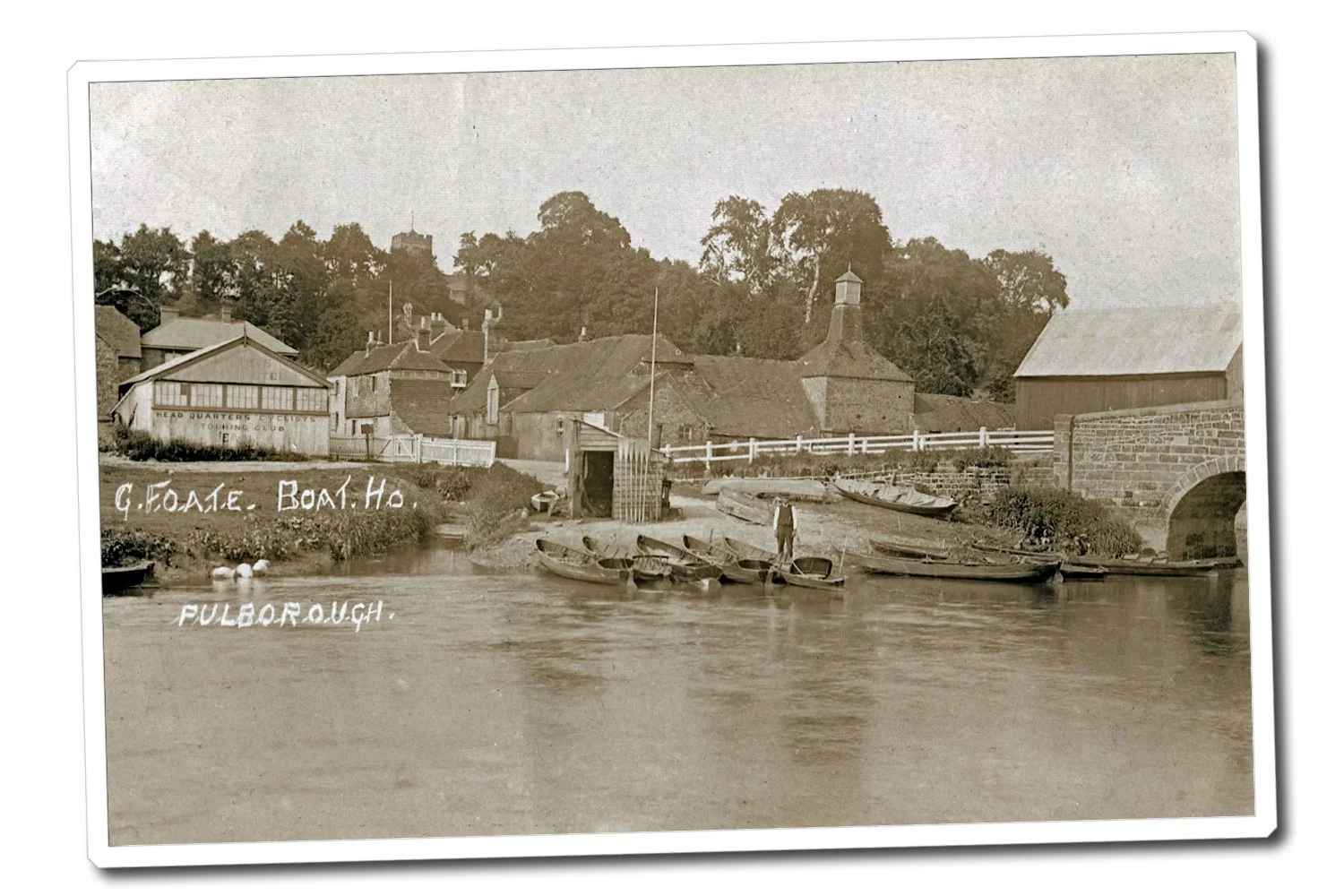
Pulborough Lower Street

Two cards this month are both of Lower Street but from different viewpoints. Recently collected, they were both sent to the same recipient, apparently by the same sender, just a few months apart. One was sent in November 1920, the other in January 1921. The recipient was Miss E. Chatfield, the Manor House, Lewes. The address of the sender was Station Road, with number 5 added on the first card.

Research revealed the likely identities of these individuals as Miss Eunice Edith Chatfield (called Ethel) who was born in West Chiltington, and Mr. Henry A. Ralph of Pulborough, a chauffeur. The angle of the stamp on both was indicative of a kiss in the so-called language of stamps of the time. There are also endearments in the text. In fact these two were married in 1922, so the romance blossomed.

Both cards were published by F. Douglas Miller of Haywards Heath and, after 1916, Worthing. These cards were probably from the latter era but the photographs used may be from earlier years. They are recognisable as Miller cards by the border at the bottom and the print style. Earlier cards were embossed with his name and sometimes identified as the Sussex Series, with some having handwritten legends.

Postcard of the Month: November 2025

Sailing Vessel Anchored in Littlehampton Harbour

This card by Frank Spry has “F.W.Spry, Photo’r, Surrey St. Littlehampton” printed on the back top corner, which is typical of his later issues from the 1920s and 1930s. Also written on the back in ink is “Commander Douglas Dixon, D.F.C.’s Yacht. Converted oyster smack”. Underneath, a separate inked comment adds “50 year old”. The vessel is shown anchored in the fairway. The flag hoist suggests a special event.

Research on the name revealed that this was probably Lt.Commander Charles Douglas Horsfall Dixon, D.S.C., RN. (1899 – 1964). He received his decoration as a young Sub-Lieutenant for courage under fire in WW1 at Gallipoli, and his naval career included training in early submarines. He retired at his own request in 1922. Dixon rejoined for WW2 and was invalided out for medical reasons in 1941.

The research also revealed that the craft in the picture was originally an oyster smack named Daisy, built in 1884 by Aldous of Brightlingsea, registered as CK6. She worked under sail until 1932 when she was sold to Dixon, converted to a yacht and renamed Dusmarie. After Dixon married his second wife, Phyllis Mary Burkett Turner, in 1933 in Holborn they seemed to have spent most of their time aboard. They sailed together on several ocean voyages including a 4,000 mile journey to Lapland and back (recounted in his book, A Sail to Lapland). The yacht still had no engine, making the voyage remarkable. It may be the conclusion of this voyage in Littlehampton, where his father was a doctor, that is recorded on the postcard. Press reports in several local papers show the date to be 15th August 1938, which would fit with the Spry postcard history.

Dusmarie sailed again to the Baltic and was left in Sweden for the duration of WW2, returning in 1945. She was rebuilt with her rig changed to a two masted yawl, and was finally fitted with an engine. During the 1950s and 1960s she was used as an adventure training ship for parties of schoolchildren. Later, still in the Dixon family ownership as a training ship for a sixth form college near Ipswich, she took part in the 1974 Tall Ships Race with an all female crew. Dusmarie was sold in the 1980s where it was based on the Deben in Suffolk.

In 2020 the vessel reverted to her original name and became a long term restoration project, still in progress, at a Maldon boatyard in 2024. She is in the National Historic Ships Register from which this information was obtained and, should she take to the water again, will be over 140 years old - at least the parts that haven’t been replaced will be!

Postcard of the Month: October 2025

PJ Durney on the Ball

According to the handwritten text on the back of this FW Spry card, PJ Durney walked on a ball from Beach Hotel to Terminus Hotel in Littlehampton, with but one fall, on Wednesday April 10th 1907. So far, no press reports confirming this feat have come to light.

The postcard was addressed to S.C. Barrett, 21 Gloucester Rd, Littlehampton, a local collector. Additional text in pencil identifies the location as the end of the journey, next to the Locomotive Inn near the Terminus Hotel. The view is east along Terminus Road.

Ball walking, often for considerable distances, seems to have been a popular activity at this time and P.J. Durney was a well known exponent. Presumably money was collected from the onlookers, and maybe from local sponsors who might have gained from the influx of people to the town and its hostelries. The individual propping his foot against the ball to keep it stationary looks like he might be the promoter!

Postcard of the Month: September 2025

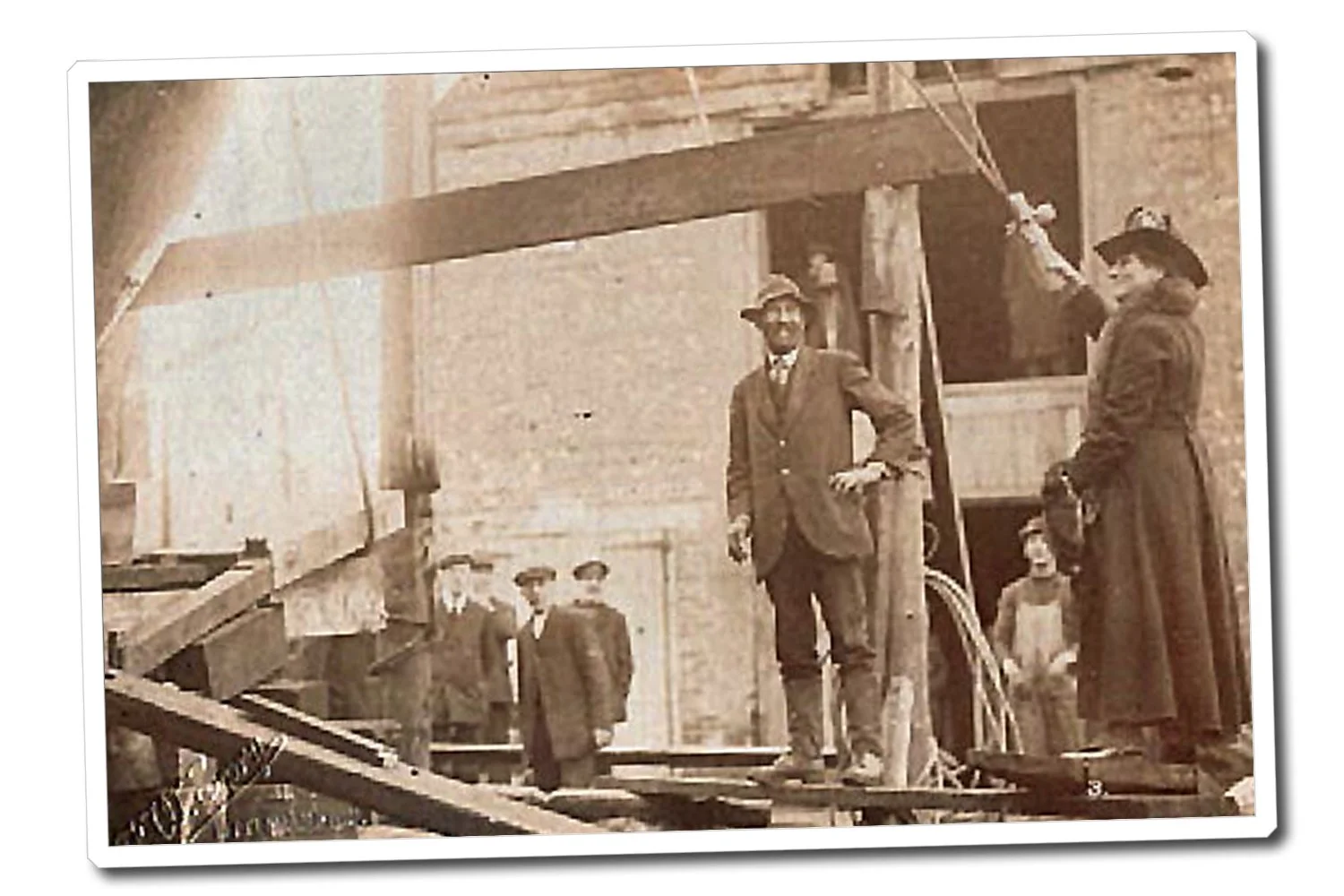
Launch of a Sailing Barge at Harvey’s Yard, Littlehampton

This postcard by Frank Spry (with his name embossed at the bottom left corner) shows the launch of an unknown sailing barge at Harvey's yard. The ceremony was performed by Eva Robinson with her husband, Arthur, watching in admiration.

The date is not known but it’s probably around 1914 according to the ‘Littlehampton’ volume in the Archive Photographs series (1998). Arthur, a member of the well known Robinson family, apparently designed sailing barges for Harvey. The slipway shown is part of Harvey’s shipyard.

Postcard of the Month: August 2025

Arundel High Street

This printed postcard shows the stationery shop at the bottom of Arundel High Street. It is part of an ‘Exclusive Photocolor Series’, possibly from Photochrom, but sold by Lapworth and Son, Market Square and High Street, Arundel. It is their shop in the picture,

In front of the shop are a series of newspaper billboards with the current headlines. The Daily Mail billboard reads ‘Latham Falls in Sea at Dover’ referring to Hubert Latham (1883-1912), a French aviator taking part in an attempted Channel crossing from Sangatte in his early plane, an Antoinette V11. He was the demonstration pilot for the company which made it and was competing for the prize awarded by the newspaper for the first crossing of the English Channel by air. It was his second attempt.

Hubert Latham’s first attempt (in an Antionette 1V) was on 19th July 1909 and had ended soon after take-off with engine failure dumping it in the sea. The aeroplane floated until Latham was rescued by the French destroyer following the flight. A few days later, Bleriot won the prize in his aircraft of the same name, becoming the first to cross the Channel.

Latham made his second attempt at the crossing in the Antoinette V11 on 27th July 1909, only for engine failure to ditch him just a few hundred yards short of Dover where he was once again rescued with just minor injury. This therefore dates the postcard to shortly after the billboarded event, perhaps August 1909.

Latham gave up flying in 1911 when the company folded. He died on a safari in Africa in 1912, reportedly trampled to death by buffalo but was possibly killed by his porters.

Postcard of the Month: July 2025

The River at Amberley

This early card by White of Littlehampton, published sometime between 1901 and 1903, shows not the main river but the side arm cut for Lord Egremont in 1803. This gave access to the Chalk Pit, via the wharf, for barges to transport imported coal from Littlehampton and to export chalk and lime for local use and further afield.

Although the railway was by this time the preferred method of transport, one of these barges can be seen tied to the bank in the background - apparently still serviceable. However, in front are two pairs of rowing boats which were probably part of the fleet hired out by the tea rooms, supplanting the trading operations here.

The postcard was sent to Miss Wood in Redhill, Surrey, in August 1909. The text mentions that the location is just by the station and looking lovely by moonlight. The village band (possibly the Amberley Prize Band shown on another card) was giving them a treat (but qualified by a question mark). The torture would soon be over, although the villagers were enjoying it. So not everyone appreciated the entertainment.

Postcard of the Month: June 2025

Swan Bridge, Pulborough

The publisher of this card, from the early 1900s, is not known. It was never posted, but the handwritten text can be seen to be in two parts. The sideways writing on the left states "Dear Phyliss, We are having a lovely time, out everyday. Today have had 3 1/2 hours on Arun" . The second part, written upside down, "To call to remembrance our 3 1/2 hours on River Arun, Thursday August 6th 1914", with "Honeymoon" underlined.

The card appears to have been kept and perhaps subsequently exchanged between the couple concerned, whose identities remain a mystery.

Postcard of the Month: May 2025

Old Canal Bridge, Yapton

Most likely published by Cecil Travers of Brighton, this card shows a typical brick accommodation bridge over the dried-up route of the Portsmouth to Arundel Canal. The photograph was probably taken around 1905. A short way off from the Arun, the canal was joined to the river at Ford and so justifies inclusion on this website.

The bridge may have carried Drove Lane over the canal and is no longer in existence, although the site is still accessible. The name of the lane suggests that, in medieval times, it allowed drovers of cattle, sheep or pigs access between the flat fields of the coastal plain and local markets, or even further to the upland grazing of the South Downs.

The canal formed part of the overall London to Portsmouth route during the mid 1800s and was featured in the book ‘London’s Lost Route to the Sea’ by P.A.L. Vine, first published in 1968. Similar photographs, probably of the same bridge, appear in his ‘London's Lost Route to Portsmouth’ (2005, pages 142 and 143).

The card, posted in 1910, was sent by ten year old Stanley George Mantell to his cousin Lilian (Lily) Esther Mantell in D'Aubigny Road, Brighton. It discusses his holiday, and describes walking to Bognor that afternoon. The address shown for the sender is c/o Mrs. Trusslea, Drove Lane, Yapton.

This map shows shows a section from Bradshaw's map of the Southern Waterways in 1832, including the location of Yapton on the route.

Another card of the canal route shows a similar brick bridge near Ford, close to the junction with the River Arun.

Postcard of the Month: March 2025

Pumping out the Cretacre

This Frank Spry postcard, probably from July 1918, shows a vessel with its hold being pumped out alongside the Railway Wharf on the east bank of Littlehampton harbour (the swing bridge can be glimpsed in the background). Part of the craft's name is visible at the rear, along with the wartime code which each merchant vessel on Government duty carried. Cretacre was a steam powered barge built out of concrete at a shipyard on the shores of Poole harbour, using concrete supplied from the Isle of Wight. Concrete was chosen because of the shortage of steel during WW1, and was used for a series of these concrete barges. They were described in detail in the November 1918 issue of the Engineer journal.

An illustration from the article is shown here.

Whether the water ingress was from rough seas in the Channel or from hull leaks is not known. Cretacre was probably part of the regular convoys carrying munitions from Littlehampton to France. Littlehampton was an Admiralty administered port during this period.

Postcard of the Month: February 2025

The Railway Hotel, Pulborough

This printed postcard, publisher unidentified, was probably produced around or just after WW1. The vehicle on the right indicates this era. The railway bridge in the background crosses the main road and leads to the station. The building faced Station Approach where cattle markets were held every fortnight until the 1950s.

The proprietor Percy Kitchin (wrongly spelt on the card) ran the hotel with his wife for 25 years. Percy was also an enthusiastic garage owner, an early Austin dealer, and responsible for the Swan Garage in Pulborough. He died in 1935. A press obituary recalled how the hotel was a meeting place for farmers from the district attending the markets, and that his interests extended to the garage which was purchased from the family in 1935 to become part of the Dreadnought group of Brighton.

In 1945 the building was renamed The Pulborough Hotel and then became the Water’s Edge in 1966, reflecting the presence of a small inlet from the Arun behind it. This served as a haven for small craft, as shown in the two different views from postcards of the 1960s.

There was also a field between the hotel and the river which, by the 1980s, possessed a rudimentary slipway. This was the original venue for launching boat rallies up the river to Pallingham, organised by the Solent and Arun branch of the Inland Waterways Association (IWA). Those rallies provided the opportunity for my early trips up the Arun in my folding dinghy Frog, starting in 1982. These eventually led to much of the groundwork for this website. More information about Frog can be found here.

The hotel was closed in 1995 and the building demolished in 1997 to be replaced by a housing complex. The remnants of the inlet became a small lagoon within this complex.

Postcard of the Month: January 2025

Timber for Littlehampton

This Frank Spry postcard offers a view taken from the west bank of the harbour opposite the Baltic Wharf, showing two visiting sailing vessels by the covered area for timber storage.

The handwritten text on the reverse identifies the craft as the barquentine Elisabeth of Marstal on the right with the information that she had delivered timber from Gothenburg on May 6th 1924. More information about Elisabeth of Marstal can be found here.

The other craft on the left is the Swedish four masted auxiliary schooner Margot from Danzig, also with timber arriving on the same date.

The card has a printed label listing Barbara J. Robinson as the collector, together with her address. She was a descendant of local ship owner Joseph Robinson, and it may be his comments on the back of the card.

It is possible that some of the timber delivered may have been used for harbour infrastructure improvements which took place later in the 1920s. Some of this activity can be seen in the other Spry postcard with pile-driving taking place during the rebuilding of the harbour side wharfing, completed in 1929. Although there is no date or text, this card shows a similar style in the printed details and both have the typical embossed angled name on the front identifying the publisher.

Postcard of the Month: November 2024

Amberley

This is a postcard of a painting by E.W. Hazlehurst (1866-1949) published by A. Vivian Mansell & Co, probably in the 1920s or 1930s. It shows the ruins of the castle and the village pond in the foreground.

More information about Amberley can be found in the Locations section, where reference to the maps on the title page shows that the castle can be seen from the Arun and also from the railway. Amberley parish bordered the river at Houghton Bridge, which is where the railway station is located.

Postcard of the Month: October 2024

The Children’s Pond, Littlehampton - a very efficient post

This postcard of the Children's Pond in Littlehampton, sent to a Mrs Wright in London, was date stamped in Littlehampton at 11.15am on April 29th, 1908.

It was then re-addressed to Woolpit in Suffolk and date stamped again at 7pm the same day - a testament to the postal service of the time.

The logo of the card's publisher shows that it was Ramsden Brothers of Worthing, who produced many views of Sussex at the time.

Postcard of the Month: September 2024

Easonian at Harvey’s Yard

The sailing vessel Easonian was originally the Spanish craft Nuestra Senora De Arenzazu of San Sebastian and was purchased by a Scottish syndicate for the Dundee Whaling Industry. She was brought to Harvey's Yard in Littlehampton to be converted and strengthened for service in Arctic waters.

Easonian is seen in this Spry postcard of the yard high up on the slipway in the background, and her Spanish name is still visible on the stern. The sailing barge in the foreground is the Clymping, built here in 1909 and possibly undergoing repairs.

Easonian was relaunched around 1920, registered under the new name in Littlehampton. She was the last sailing vessel of her size to appear on the local register.

In the other postcard by Spry, Easonian is in Littlehampton harbour soon after launch.

Sadly she became a total loss in September 1922 off Kerketen Island, Nunavut in Cumberland Sound on the Canadian seaboard. She caught fire and burned to the waterline. Fortunately the crew were rescued by another Scottish sailing vessel Albert.

Kerketen Island is now one of Canada's historic sites as a significant whaling station for the period from 1857 to 1923.

Postcard of the Month: August 2024

Burpham Croft and a Railway Fraud

Burpham Croft was previously known as Elm Croft and was home for three women between the 1850s and 1880s; Miss Charlotte Harrison, Mrs. Jessie Munro and her adopted daughter Eleanora Elwin.

Mrs. Munro was the assumed name of Jessie Redpath, the innocent wife of Leopold Redpath. Redpath, a convicted fraudster, had been found guilty of a massive fraud involving shares of the Great North Railway; a notorious crime of the 1850s for which he had been deported to Australia.

All three women are buried close together in St. Mary's churchyard. Both Charlotte Harrison and Jessie Munro funded stained glass windows in the church, and were well respected in the village.

It would be gratifying to know that these women were the figures seen in the garden in the postcard of Burpham Croft, but they most likely pre-dated the photograph.

Further details of the story can be found in the following sources:

‘The King's Cross Fraudster - Leopold Redpath, his Life and Times’ by David A. Hayes and Marian Kamlish (2013).

‘The Stained Glass of Burpham Church’ by Trevor Cooper (2018).

Postcard of the Month: July 2024

Mr Grinsted of Bury Stores

This John White card, posted from Pulborough to Miss H. Sully in Essex on February 5th 1909, shows the Bury Stores owner, Philip Grinsted, leaning on a fence admiring the view of the Downs from the village. The sender may have worked in the shop, as she mentions "very quiet trade" and that "you would not like to be a shopgirl".

More about Philip Grinsted and Bury Stores can be found here.

Postcard of the Month: March 2024

Sailing Vessel off Littlehampton

Frank Spry was one of the few postcard publishers who regularly produced work showing vessels under sail, arriving or departing. Sometimes the vessels were heavily laden and low in the water, or on other occasions empty and in ballast riding high out of the water, as shown here. Possibly Frank Spry was aboard ‘Jumna’’ when she provided towage and a pilot in or out of the harbour.

This vessel is not identified by name, although ‘OERNEN’ is written on the back in pencil. The Plimsoll Line can be seen on the ship's side, suggesting she was empty after delivering her cargo to Littlehampton, perhaps with just enough added ballast to maintain stability under sail. The flag shows her to be Danish, possibly from Marstal, where many similar craft were built and operated.

Three crew are visible on deck; one at the helm, the other two preparing the mizzen sail for hoisting. She would have needed every bit of her canvas to keep her under way in the light wind from the west.

The photograph was probably taken in the early 1900s, but more research will be needed to confirm the date and the vessel’s identity. Any further information would be very welcome.

Postcard of the Month: February 2024

So many Words!

This relatively unremarkable postcard of Toddington, north of Littlehampton, was sent to Miss Bertha Symes, of Collier's Wood. It contains more than two hundred words, mostly legible, not counting the address!

The card reveals a carefully crafted message on the back, some of it written in a simple code. Maybe the sender, George, sought to discourage anyone other than the recipient from reading the content, or perhaps this was a private game that they played.

Toddington was clearly rural at that time, probably best known for its tea rooms which featured on a number of postcards of the period.

This card, published by White & Son, was posted in Littlehampton on October 15th 1907.

Postcard of the Month: January 2024

Worthing Belle leaving Littlehampton

This is a White & Son card, posted in August 1909, and probably photographed a few years earlier. The excellent picture features some good details of the vessel, including the bridge and steering position behind the funnel. She is positioned by the Nelson steps, with the pub of that name showing behind the mast, and is possibly in the process of loading passengers. The signs on the wall of the building show ‘Lambert and Norris, noted Arundel Ales’ as the brewer. The entrance to the building to the left is labelled the ‘Commercial Hotel’.

The Nelson was originally named the Victory Inn in 1840, the name being changed later to the ‘Nelson and Victory’. When the building was rebuilt around the original structure in 1897, it became ‘The Nelson’.

For more pictures and details of the Worthing Belle, see the entry in the Vessels section under Steam Vessels. Her skipper, Capt. James Trenance, can been found in the Characters section.

Postcard of the Month: December 2023

Christmas greetings from Pulborough

This view from the Arun shows one of the lime kilns on the left of the photograph. Several of these were situated on the north bank between the river and the backs of properties on Lower Street. A few, in ruins, are still extant but are much overgrown and largely inaccessible. Lime was one of the major cargoes transported by Arun barges and was an important commodity both for farming and industry.

The back of the card back shows Christmas greetings from Hamilton Law to Mr. & Mrs. D.H.J. Hartley. It was posted in Pulborough December 22nd 1907, and redirected from London to Birmingham. Hopefully it arrived in time!

Research reveals that Law and Hartley were contemporaries from 1898 at Clare College Cambridge which may be how they were acquainted.

Hamilton Law (1879 - 1960) declared himself on the census to be a musician, composer, teacher and critic.

David Harvey Johann Hartley (1879 -1955) was a Barrister at Law who had married Kathleen Laura Vyvyan Negus earlier in 1907.